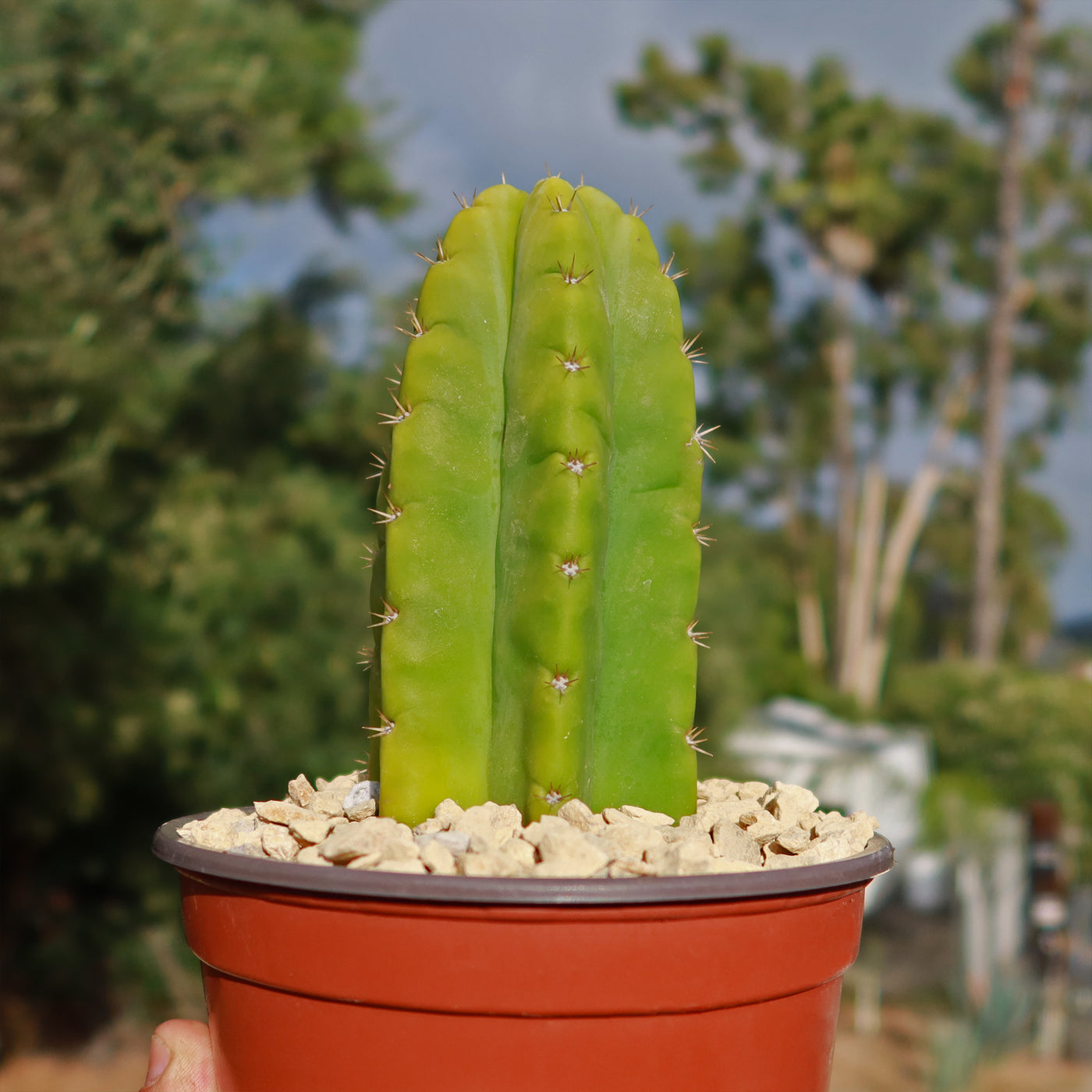
SKU: 12128265663
san pedro cactus order online

san pedro cactus order online Shop 'San Pedro Cactus - Echinopsis pachanoi' Care and Growing Guide

Sale price$20.79 Regular price$23.10
Save 10%

Pay in installments of $5.78 with ShopPay, AfterPay and Klarna

Shipping Estimate
USA
  • USA
  • CAN

Ships within 48 hours · Estimated delivery Sep 23 - Sep 28

Promo Codes Available:

For Your Every Summer RSVP, with Code: SUMMER15

Description

san pedro cactus order online Shop 'San Pedro Cactus - Echinopsis pachanoi' Care and Growing GuideIntroducing the San Pedro cactus, also known as Echinopsis pachanoi (Syn. Trichocereus pachanoi) or Trichocereus Echinopsis pachanoi, which is among the superstars of the cactus world. This fast growing columnar cactus is also known as the Wachuma and Huachuma. Standing tall and proud, this magnificent San Pedro cactus columnar beauty can reach heights of up to 20 feet and spread its branches wide, up to six feet! With stems that range from vibrant

Introducing the San Pedro cactus, also known as Echinopsis pachanoi (Syn. Trichocereus pachanoi) or Trichocereus Echinopsis pachanoi, which is among the superstars of the cactus world. This fast-growing columnar cactus is also known as the Wachuma and Huachuma. 

Standing tall and proud, this magnificent San Pedro cactus columnar beauty can reach heights of up to 20 feet and spread its branches wide, up to six feet! With stems that range from vibrant green to mesmerizing blue-green shades, San Pedro is a true showstopper in any landscape. As your San Pedro cactus plant matures, its colors deepen and intensify, adding even more charm to its already captivating presence.  


When the San Pedro cactus flowers bloom, they emit a sweet fragrance that attracts pollinators like bees and butterflies.

The flowers are usually large and trumpet-shaped and come in various colors, including white, cream, and yellow. The petals have a delicate texture and often have a waxy appearance.

The fragrant flowers usually open during the day and close at night. They have a short blooming period, typically lasting for a day or two.

During the blooming season, which usually occurs in late spring or early summer, multiple flowers can bloom at once, creating a captivating sight.

The San Pedro cactus flowers are not only visually appealing but also have cultural significance. In some indigenous cultures, the flowers are used in traditional ceremonies and rituals. They are believed to have spiritual and healing properties.

The San Pedro cactus also has Pitahaya red San Pedro cactus fruits. These fruits are known for their sweet and refreshing flavor, making them a popular choice for consumption. Additionally, they are rich in antioxidants and vitamins, providing numerous health benefits.  

When and How to Water Your San Pedro Cactus 

San Pedro cactus is a drought-tolerant plant that can survive in dry conditions for long periods of time. However, regular watering is still needed to stay healthy. Generally, the San Pedro needs to be watered once every two weeks. During the summer months, when temperatures are high and the plant is actively growing, it may need to be watered more frequently.  

When watering your Trichocereus Echinopsis pachanoi, be sure to soak the soil thoroughly and allow it to drain completely. To prevent root rot and other issues, avoid overwatering.The leaves may become dry and brittle, and the cactus may stop growing if it is underwater. Over time, the San Pedro cacti may start to lose their shape and become misshapen.  

In addition to these physical symptoms, underwatering can also make the cactus more susceptible to pests and diseases. To keep your San Pedro cactus healthy and thriving, it is important to water it regularly and provide it with the right growing conditions. 

Light Requirements - Where to Place Your San Pedro Cactus

When grown indoors, your San Pedro cactus should be placed in a bright, sunny location where it can receive at least six hours of direct sunlight each day.

For outdoor cultivation, the San Pedro cactus requires a lot of sunlight to grow and thrive.

In its natural habitat, this cactus is exposed to direct sunlight for 4-6 hours each day.

If you live in an area with a lot of cloud cover or limited sunlight, you may need to supplement your cactus's light with artificial grow lights.

So, let's give your San Pedro cactus plant what it deserves—just the right amount of light to bloom into the ultimate showstopper! 

But beware; too much sun can lead to burns, so make sure you gradually increase exposure or bring it indoors during a heatwave. And if your Echinopsis pachanoi isn't getting enough light, it'll start stretching toward its source.

Optimal Soil & Fertilizer Needs 

Use well-drained soil that is designed specifically for your Echinopsis pachanoi cactus. These specialty soil mixes have been precisely developed to imitate well-draining desert soils. Commercial cactus soil is affordable and available online or at Home Depot.

Planet Desert specializes in cacti and has a specialty cactus potting mix that contains 5 natural substrates and organic mycorrhizae to promote the development of a strong root system that helps your San Pedro cactus thrive. 

When it comes to fertilizing your San Pedro cactus plant, it only needs a small amount of fertilizer applied once a year in the spring. Cacti prefer fertilizer with lower doses of NPK, with a maximum ratio of 5-10-5 which is higher in phosphorus than nitrogen. Remember, overfertilization can lead to root rot or even the death of the plant, so be cautious! 

Hardiness Zones & More 

San Pedro cactus is a hardy plant that can grow in a variety of different climates. It is native to the Andes Mountains, where it can be found growing at high altitudes in a range of temperatures. In the United States, San Pedro cactus is typically grown in warm, dry climates such as those found in the southwestern states. 

When growing indoors, the San Pedro cactus prefers a warm and dry environment. It thrives in temperatures ranging from 55°F to 75°F. Aim for a humidity level of around 40% to 50% to create an ideal indoor environment for your San Pedro cactus.

For outdoor cultivation, this cactus is hardy in USDA zones 8–11, which means that it can tolerate temperatures as low as 20 degrees Fahrenheit.

If you live in an area with extreme temperatures, you may need to take extra precautions to ensure that your San Pedro cactus Echinopsis pachanoi, stays healthy. 

In addition to its hardiness zone, it is also important to consider the humidity requirements of the San Pedro cactus. This cactus is adapted to dry, arid environments and does not require a lot of humidity to grow. In fact, high levels of humidity can be detrimental to the health of the plant, as they can promote the growth of mold and fungal diseases. 

When growing San Pedro cactus, it is important to provide good air circulation and avoid overwatering to prevent the buildup of excess moisture around the base of the plant.

Wildlife - San Pedro Cactus Attracts the Following Friendly Pollinators

The San Pedro Cactus flowers attract several friendly pollinators such as bees, butterflies, and hummingbirds. These pollinators are essential for the reproduction of the cactus and play a crucial role in maintaining the ecosystem's biodiversity.

Butterflies
Bees
Hummingbirds
Lady Bugs
Multi Pollinators
Other Birds

According to ASPCA, the San Pedro Cactus is safe for humans but can be mildly toxic to cats and dogs if ingested in a large amount. However, it is safe to touch and handle, making it a popular choice for ornamental cactus gardens. However, it is important to keep San Pedro Cactus out of reach of pets to prevent accidental ingestion.

How to Propagate Your San Pedro Cactus

Propagating the San Pedro cactus can be done through seeds or cuttings, but each method has its pros and cons. While cuttings are a quicker option, this method involves cutting off the top of the plant, which permanently alters its tall, elegant columnar form. For this reason, propagation by cuttings is only recommended if the plant has already broken or been damaged. In such cases, you can take a healthy segment, allow it to be callous for about a week, and plant it in well-draining soil to root. However, this approach is less ideal for those who wish to maintain the plant's natural aesthetics.

Seed propagation is a method for cultivating new cacti plants, and preserving their beauty. Harvested from mature cacti's fruit, seeds are cleaned, dried, and sown onto a well-draining soil mix. Despite the patience required, this method allows for healthy plants without compromising the parent cactus's appearance, despite the need for indirect sunlight or grow light.

Key Takeaways

  1. Unlike many other cacti, the San Pedro grows quickly, often reaching heights of 10–20 feet under ideal conditions, making it a popular choice for ornamental gardens.
  2. This cactus is highly adaptable, thriving in a variety of climates and requiring minimal care. It is drought-tolerant, hardy in USDA zones 8–11, and grows well in nutrient-rich, well-draining soil.
  3. San Pedro Cactus is a drought-tolerant that thrives in arid conditions and requires minimal watering. It is a popular choice for xeriscaping and landscaping in dry climates due to its ability to store water in its fleshy stems.

Final Thoughts

Overall, the San Pedro cactus (Echinopsis pachanoi) is a remarkable plant with unique features. It is characterized by its tall, columnar shape and beautiful white or yellow flowers. The cactus can grow to impressive heights, reaching up to 20 feet in optimal conditions. Its spines are relatively short and are arranged in clusters along the ridges of the cactus. The San Pedro cactus is a low-maintenance plant that thrives in well-draining potting soil and enjoys ample sunlight. It prefers a dry environment and can tolerate drought, so it should be watered sparingly, allowing the soil to dry out between waterings.

Don't miss out on this opportunity to add something truly exceptional to your garden. Buy San Pedro cactus for sale today to enhance your collection! 

Shipping Notes
  • Free Standard Shipping on $100+ Orders to the USA.
  • Except Preorder products are shipped in 48 hours.
  • Delivery to the USA:
  1. Standard Shipping : 3-10 business days
  • If time is of the essence, please consider selecting expedited delivery for faster service.
Exchange/Return Notes
  • We offer a 30-day return/exchange service after receiving.
  • Final sale items are not eligible for returns or exchanges.
  • To process your return/exchange, please contact us at [email protected]
  • Please click here for more details>>> Return & Exchange Policy
SKU: 12128265663

Discover Niche Categories That Outsell san pedro cactus order online

Top-Converting Item to Boost Your Average Order

4.8 ★★★★★
Based on 10 reviews
Sort
Highest Rating
Newest First
Oldest First
Product Reviews
G
Verified Purchase
Gary Moreau, Author
Massapequa, US
★★★★★ 4
Marx had the proletariat, Mao had the farmers, America has the owners of financial capital
Format: Kindle
What makes Jonathan Levy’s book so informative is that it is truly a parallel history of its politics and its economics. And only by viewing these two intertwined paths side by side can you truly understand the myth of the American free market. America’s politics and its economics have never, since the country’s founding, been separated. The state has been an integral part of everything economic to an extent that would make the most rabid socialist gasp in horror. The only difference is that while the Marxist state stood side by side with the proletariat, and Mao built the number two economy in the world on the support of farmers, America built its economic marvel on the backs of, and for the benefit of, the owners of financial capital. That’s not all bad, mind you. It takes workers, farmers, and the owners of capital to build a modern economy. The tension comes when there is a lack of balance between the importance the state attaches to each. And there can be little surprise that America’s politicians have put the owners of financial capital at the top of their list of priorities. Politicians, after all, can do nothing without power, and power comes via the electoral process, a process that is today fueled by obscene amounts of money. And who has all that money? The American economic narrative is a misleading tale of meritocracy and free markets. The Horatio Alger-based myth is that you are only limited by your skills and your ambition. And like most enduring myths there is a thread of truth to it. Many successful people truly deserve what they have achieved. But does anyone really possess $150 billion of personal merit? Can we statistically accept that the wealthiest nation in the world is also one of the most financially unequal without seeing a pattern of bias? Perhaps the most selectively quoted book in history is Adam Smith’s “Wealth of Nations”, published, strangely enough, in 1776. Often credited with being the father of capitalism, Smith argued that markets free of excessive regulation would be more efficient than markets that were overly regulated, although Smith “made no categorical separation between the political and the economic, or state and market.” Smith did, however, warn against the socially destructive power of monopolies, which unregulated markets will not protect against, and he correctly predicted that the excessive division of labor would lead to a degree of labor and wealth inequity that would destroy society. At the time when US Steel, General Electric, and General Motors, among many others, were the power behind America’s global economic hegemony, most Americans earned a living through wages. And those wages were made possible by long term fixed investments that created jobs. They were generally big bets that took a long time to earn a return but that aligned with the jobs-first priorities of most companies. (Employees first, communities second, shareholders a distant third.) And while not every employee enjoyed the same salary, the differences between the top earners and the average earners was a fraction of what it is today. That era, of course, is long over. The current economy is geared toward the creation of wealth through the short-term investment in assets that will appreciate rapidly and are highly liquid. At the moment that is the stock market and synthetic financial tools pedaled by hedge funds, banks, and the like. The problem is that the wage market encompassed much of America. The asset appreciation market encompasses only a tiny sliver of the richest among us. There is spillover, of course. The lawyers, analysts, consultants, bankers, and sales people who serve the asset appreciation market are doing quite well. But the man or woman who has less education and who might have made a decent living in a steel mill or car assembly plant, has lost out. And despite what the politicians will tell you, the gap is getting wider. (I spent a career in corporate industry, have a college degree in economics, have been a CEO, and have served on four public company boards. I know enough to know that Levy knows what he’s talking about.) The second important point to come out of all this is that economics is not really a “science” as most people think of that term. There is a shared jargon and there are commonly accepted principles. The very idea that there is an economy that is distinct from all other aspects of human existence, including the state, however, is a relatively recent concept. The weakness of the distinction, in fact, is clearly demonstrated by the remarkable reality of just how diverse the history of the American economy is. The sun doesn’t always rise in the east in the world of economics. In each of the economic eras Levy describes it is stunning how few people actually formulated the thinking that defined them. I will join some of the other reviewers in suggesting that the author could have spent more time explaining some of the jargon inevitably found in a treatise on economics. The layman obviously wasn’t his target audience but the book, I believe, could have read more smoothly and been much, much shorter. (The editor and publisher have to take some of the blame for this.) Even if you have to slog your way through the more tedious sections on global capital flows and such, however, you’ll get something from the book even if you’ve never set foot in an economics classroom. If you get no more than the fact that the free market is a myth and that most long term capital that actually creates jobs and income for the average American is actually provided by you, the taxpayer, not the Wall Street capitalist, you will better understand why there is so much division in our country right now. We don’t have a democratic economy. The young wonders of Silicon Valley would have nothing if it wasn’t for your tax dollars and your pension plan, if you’re still lucky enough to have one. We can do better. We have to. The economic inequity we have now is simply not sustainable.
WAS THIS REVIEW HELPFUL?YesReportShare
Reviewed in the United States on August 19, 2022
J
Verified Purchase
Jose Calderon
Draper, US
★★★★★ 5
Good value for the money.
Format: Hardcover
Book in excellent condition, delivered promptly.
WAS THIS REVIEW HELPFUL?YesReportShare
Reviewed in the United States on May 20, 2025
J
Verified Purchase
Jared Dean
Belleville, US
★★★★★ 5
Great read.
Format: Paperback
Gives a great perspective of how technology has developed and shaped the economy.
WAS THIS REVIEW HELPFUL?YesReportShare
Reviewed in the United States on January 21, 2024
J
Verified Purchase
james hammill
Whiting, US
★★★★★ 5
How Capitalism Shaped America
Format: Hardcover
Very impressive analysis. Unfortunately the author ended his analysis in 2010. Wish he had offered some thoughts on what should be done as opposed to what is being done in this age of economic chaos.
WAS THIS REVIEW HELPFUL?YesReportShare
Reviewed in the United States on August 19, 2021
J
J. Miller
Bozeman, US
★★★★★ 3
Some good footnotes to other histories
Format: Audiobook
This book is impressive in two key ways: first it re-surfaces recurring elements in the political/economic intersect over time (the on-again off-again use of "the gold standard," the company invasion into the intimate life of the laborer) and second it gets into the gory details of policies and logistics that shaped or limited major historical events (like the availability and movement of gold going into WWII). That said, it's pretty massive for providing just those two things. It comes up weaker from Nixon on to today which undermines its contemporary relevance: it stamps everything from 1980 on as "chaos" and tries to back away slowly. It spends some time on the change in stock ownership of the 1980s (prefer Ho's Liquidated or Nace's Gangs of America; the pivot from pensions to 401ks is lost, Supermoney is not mentioned), spends time on Enron (see also McLean's The Smartest Guys in the Room) but seems to mostly ignore terror and catastrophe (consider Klein's The Shock Doctrine), spends time on the 2008 meltdown (prefer Lewis's The Big Short and Foroohar's Makers & Takers) but comes up short of Occupy Wall Street, VC-fueled gig economy corporations and cryptocurrencies. I'm suspecting that the "Chaos" isn't so much chaos but rather "Distributed Tactical Illegibility" (to borrow from Scott's Seeing Like a State): where the control of information can be used to cultivate socioeconomic advantage, then powerful people within a state will maintain their privilege through obfuscating the information they're using to create and maintain that advantage -- this is why insider trading is illegal as an abuse of power and trust *but also legal for members of the US legislature*. It's also a bit weak (at least in Audible form) of noting which bits of economic history would be echoed or reversed over time; tracing the evolution of a social construct through a twisting maze of legal decisions to current incomprehensibility does have this effect. I did find its larger position interesting, if perhaps a bit lost in the larger prose, that capitalism is about pricing the future into the present and it's gone off the proverbial rails because informational ubiquity compounds short-termism to collapse the future into the present in both public and private enterprise. Or, to put it another way, money can't escape the gravity of our economic expectation for near-horizon growth to invest in a future that our larger society wants and might reasonably expect and while legislators need to govern for the long term they're only elected for the short term and judged by people's everyday-experiences of the social-economy.
WAS THIS REVIEW HELPFUL?YesReportShare
Reviewed in the United States on September 20, 2021

recommand products